Blog

Lesson #4 Calculating How Much Rya Yarn You Will Need

Hi, FriendsDSCN6910

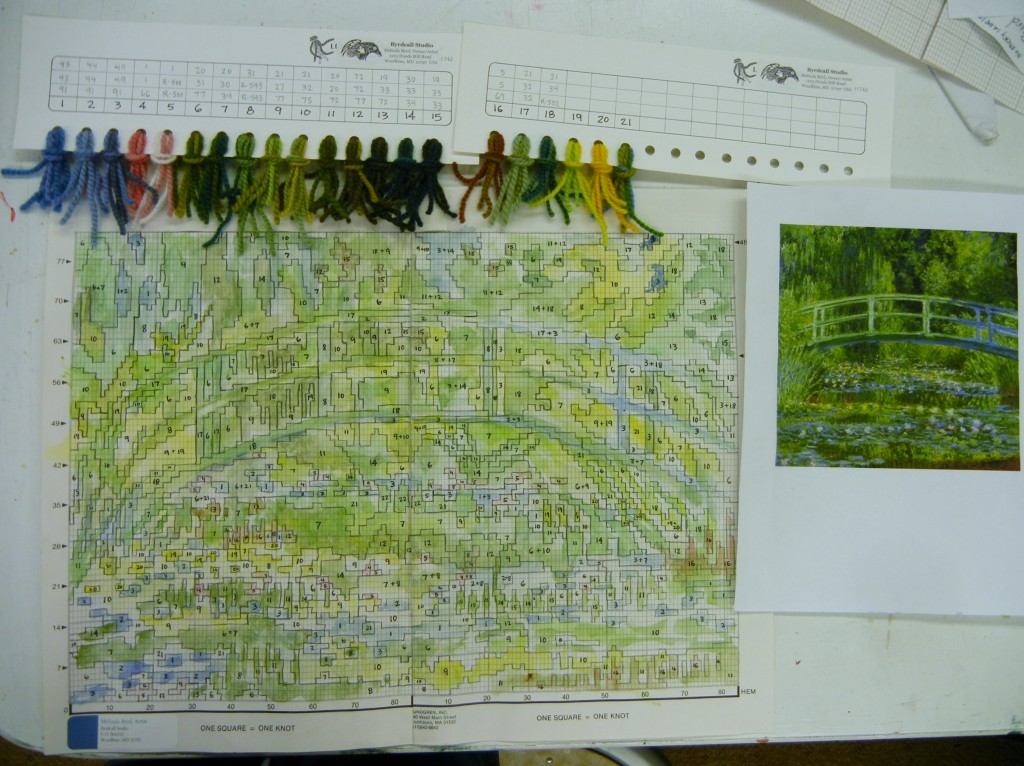
In lesson #3, we marked all the color areas on the graph paper with a corresponding yarn blending number which we also tied to our threading card for reference, like a paint by number painting.  (Oh no, don’t glaze over yet!)  To determine the amount of yarn we’ll need, first let’s do it mathematically so we know the ballpark amount.  This technique is really easy, and I can in a moment tell you how much yarn any given backing will require by multiplying the number of knots that can be made across a horizontal row times the number of rows in the rug.

With this Monet’s Bridge design, I have hemmed two (2) 34″ wide rayon and linen backings which each can hold 84 knots across the row.  84 x 2 = 168 knots across the row.  In this backing there are about 21 rows per foot and this is a 4-foot tall rug,  I happened to hem the backing in a way that allows for 82 knotable rows.  So our graph is designed to be 168 knots x 82 rows.  (Calculator, please.)  168 x 82 = 13,776 knots in the entire rya.

With this number, you can figure out lots of information.

  • If you make 150 knots per hour, it will take you 91 hours to knot a rya this size
  • If you make a loop (pile) that is about 1 1/2″ long, you will get about 325 knots from a skein.  13,776 knots divided by 325 knots per skein  = 43 skeins needed for this 4′ x 6 ‘ rya.
  • If you wanted a 2″ long pile, you would get about 300 knots from a skein.  So how many skeins would YOU need to knot a 4′ x 6′ rya?  Calculators welcome.
  • If you don’t like complicated stuff, and you hate math, you could simply say, “OK, my rug needs 43 skeins of yarn, I will order a mixed bag of the colors I need–maybe only 30 skeins, then I’ll see what I run out of, and order more of that at that time.”  I am fine with that.  It gets you started, and by the time you need more yarn, you’ll have a good idea of future needs.

If this doesn’t really interest you, don’t bother reading any further!  But if you are one of the many folks who has asked for this and can not wait for my illustrated book to come out, brace yourself…. here comes the real math with no apologies.

Here is the threading card to show color combinations matched with a number to go on the graph.

Here is the threading card to show color combinations matched with a number to go on the graph.

For each color combination threading you have created on your threading card, count–or estimate–the number of knots in your rug of each of those color combinations.  I usually count by 10’s or square inches on the graph which have 70 knots.

Worksheet for tallying knot counts and math to determine how much of each color Part I.

Worksheet for tallying knot counts and math to determine how much of each color Part I.


Now I agree, that is a lot of counting and numbers.  Now we’ll make sense of them.  The last column on the right (below) tell us how many skeins of each pure color we need to order to make our Monet rug.  Notice only 1/4 skein is needed in certain lesser-used colors.  Lots of 1/2 skeins.  As my grandparents did, I also am happy to split skeins for rya rug makers.  It can save you a lot of money to only buy 1/4 instead of a full skein of every color.

There may be easier ways to do this, but I don't know what they are.  This actually works and doesn't take as long as you probably think it does.

There may be easier ways to do this, but I don’t know what they are. This actually works and doesn’t take as long as you probably think it does.


Rya Monet yarn pile

I pulled all the yarn from the storage shelves for making this rug.  Here is what the pile of supplies looks like.  So now, all that is left is to have Bill stop by to reacquaint himself with rya rug making, give him a mini-lesson until he feels totally comfortable with the project that will take him about 90+ hours, then home he goes to work on his rya at his leisure.  I can’t wait to see the design become reality.  I’m sure Claude Monet is thrilled too.

PS.  As I was writing this all down for you I was a little mortified that I had chosen such a detailed design with which to explain the yarn calculations.  I’ll go with a more basic design next time.  My book will have it MUCH more basic to start, but this degree of difficulty is good to know if you want to design your own from paintings for example.

Questions?  This is a good place to ask.


Lesson #3 in Designing a Rya Rug (with a little help from Monet)

2014-08-05 12.36.56If you are just discovering this mini-lesson out of the blue, go to my previous blogs to get the background story.  In the last lesson, I had painted the special graph paper with a general idea of the color tones I was going for, then with a pencil I “squared off” all color areas so there was no question about which color zone the square was in.2014-08-05 14.03.49

Rya yarn samples-rauma and Lundgren

These are yarn sample cards. There numbers on these cards refer to the pure color of the dyed yarn, not blendings.

Next I used my yarn sample cards to pick out the colors I am going to mix to make the color combinations.  My grandmother always used to say that making a rya rug was like “painting with a needle.”  She was right.  The yarn colors are like the pure paint squeezed from the paint tube onto the palette.

Pure colors are fine, but the magic of rya comes from blending them with each other.  I mean, why wouldn’t you?  You put three strands on a needle to make the knot, so imagine all the color combinations you can get:  all 3 the same color, 2 of one color and one of another color, and all 3 different colors.  Ideally, when you create a threading, you should be able to squint your eyes and see it as one shade, but there are sometimes exceptions to that rule.  (I’ll explain those details in my book.)

Here is the threading card to show color combinations matched with a number to go on the graph.

Here is the threading card to show color combinations matched with a number to go on the graph.

So I created the “palette of mixed paints” which I call the “threading card.”  To make a threading card just use a paper hole puncher, punch a line of holes, then number each hole from 1 – 10 or 20 or what ever.  Then like a paint-by-number kit (but a whole lot cooler!) you can assign color numbers to your graph paper.  It is just a guide and you can always adlib.  So look closely at the yarn combinations threading card.  The #1, 2, 3… represents the number that I can easily write on the graph paper.  The three numbers written above that number tell you the ID number of the pure yarn color.  If it is a Lundgren Rya yarn, it is from #1-91.  If it is Norwegian (Rauma) it is a 3-digit number in the 500’s.

I have given a threading number to each color area.  I'm actually not trying to match my painting so much as I am trying to match the colors of Monet's painting--my painting is just a general guide.

I have given a threading number to each color area. I’m actually not trying to match my painting so much as I am trying to match the colors of Monet’s painting–my painting is just a general guide.

DSCN6902

So here is where this lesson ends. Oh yes, these lessons are in real time. Next time we’ll do some calculations. I’ll show you two ways to figure the yarn quantities out.

Next I took on the task of assigning a threading number to every single squared off color area on the entire graph.  OK, I admit, that is a little tedious, but someone has to do it. (You can do it.)  And a design that resembles an abstract Monet is very forgiving and you can’t go wrong…(well, maybe you could, but no one would know–that’s what I mean.)

So what’s left in this lesson series?  How many skeins of all of these colors do I need? Where do we begin this rya?

Stay tuned!


Lesson #2 in Creating a Rya from a Painting

Monet-5-ready for painting

Last week, I prepared the backings by hemming them to the desired length.  Now I will show you how I take a painting and adapt it so it can be knotted as an off-loom rya.  The design I am working on is from a painting by Claude Monet, but this could just as easily be an original pastel or oil painting, or a zoomed-in abstract from a colorful photograph.  Designs are everywhere.

2014-08-05 12.05.12

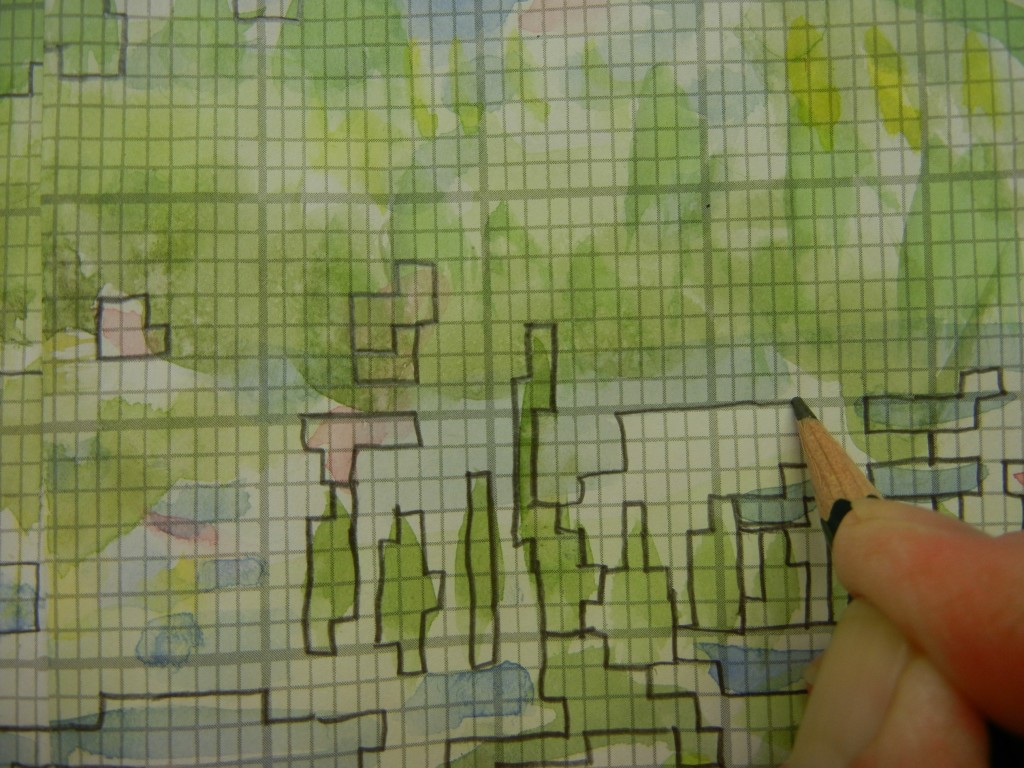
I like to use diluted watercolor paints so I can see the graph lines as I work.  Even if an area was going to be black, I would watercolor paint with gray just to give me the idea of dark or black.  Note that the graph paper is not standard.  In a one-inch-square there are 70 smaller squares representing where the knots will be.  (See the close-up shots below.) I carry this special graph paper if you want to give a shot at designing your own someday.  As I paint, it dawns on me that I ought to be thinking yarn-colors, not paint-colors, so I grabs some color samples.  (I know that is not so easy for you.  If you are serious about designing a rya, I’d recommend a yarn sample card set with about 80 colors. My Yarn Samples as sold on etsy.)2014-08-05 12.16.00

So I roughly paint a similar image to the inspiration, dabbing in color and thrust and shapes.  I avoid too much detail because detail doesn’t translate well into the moving pile of a rya rug.  Luckily Monet did great organic flowing designs.  Here is my watercolor nearly complete.  Remember it is just a guide, not a literal painting.

2014-08-05 12.26.57

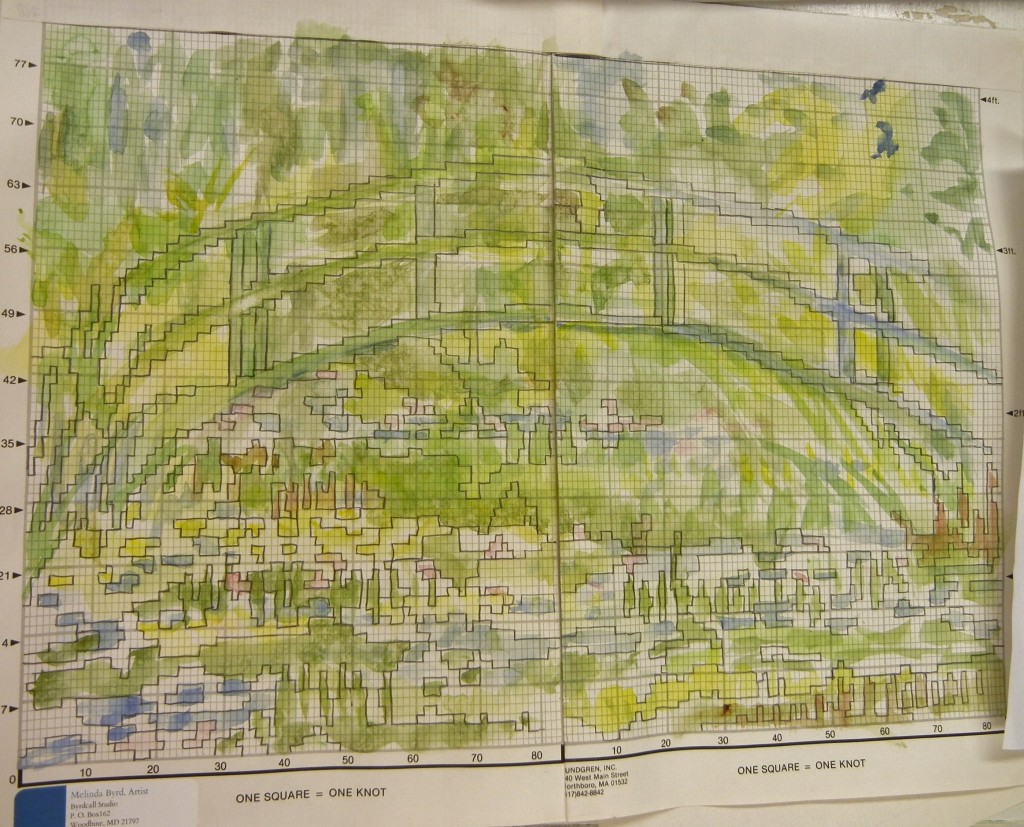
As soon as I am happy with the feel of the painting, I start to “square-off” my painting lines into color areas for the yarn.  It is fun to follow a curved line making only horizontal and vertical lines.  That is squaring off.  Each of those squares will be a knot with one, two, or three different shades of yarn.2014-08-06 11.43.45

And another squaring-off illustration.  When I am painting, I pay no attention to the grid lines.  Don’t even try to paint according to the grid.  Squaring off will make it look as though you planned it out very carefully.2014-08-06 11.42.29

2014-08-06 15.21.02I will leave you today with this image as I walked away from it this evening.  It is more than half squared off.  In the next work session, I’ll show you how I make a corresponding color card showing exactly what color yarn will go where.  Any questions?


Lesson #1 Rya of Monet is Now on its Way!

Getting off square one is always the most difficult part of a job.  Since I promised in my July Newsletter that I would have progress on the designing of a custom “Monet” rya kit order for Bill, I am happy to say it’s happening before I write the August Newsletter.

Bill wants a horizontal rya for a wall hanging behind his bed: 4 feet tall and 6 feet wide approximately.  He wants it to have the general “feel” of Monet’s Bridge over the Water Lily Pond, but not have it look like it’s supposed to BE the painting.  So my goal is to design a colorful abstraction of Monet’s bridge on graph paper with a yarn color chart for him to follow.  Here is my progress of the day:

Monet-cutting backing

I selected the most appropriate backing for the size.  It is 34.5″ wide.  Two stitched side by side will be almost 6′ wide.  Perfect.  So I cut it to be 4′ long with an extra several inches to allow for a hem.  Both pieces have to have the exact same number of knotting rows so they match up when stitched together.  (Notice that my grandmother–founder of Lundgren Rya–is watching over my shoulder.)

Monet-hemming

Then comes the hemming with my sturdy old Singer.  I zigzag the cut edge so it won’t fray as I handle it, then fold two rows over, zigzag them together, then straight stitch twice to be sure the hem is stable and permanently locked closed.Monet-hemmed for rodFor Bill I am making a nice open hem on the top so he can slide a rod for hanging through the tunnel.  It will keep the rya wall hanging nice and straight.Monet-4preparing the graph paperNow both backings are hemmed and ready.  Time to prepare the graph paper.  Luckily, this graph paper was designed for this backing.  There are 84 squares across the bottom of the paper and 84 knots will be made across the bottom of the rya. (Coincidence?) There are 82 rows (see those stripes?) in a 4′ backing.  So watch how I adapt the graph paper…Monet-5-ready for paintingI folded the center margins back so the graph lines match up perfectly.  I also cut the top off the graph paper and folded an inch of paper down for a white border…just for the heck of it. Now the graph paper is ready for the design.  AND I am ready to jump in for the fun part.  Stay tuned.  I’m going to be working on this tomorrow.  Any questions?

Show me your Rya Projects!

In a recent newsletter, I asked for those of you who are making progress on ryas–or have just finished one–to send me pictures for the newsletter.  It is really fun to hear your designing stories.  Here are a few I received.  More to come….

bild

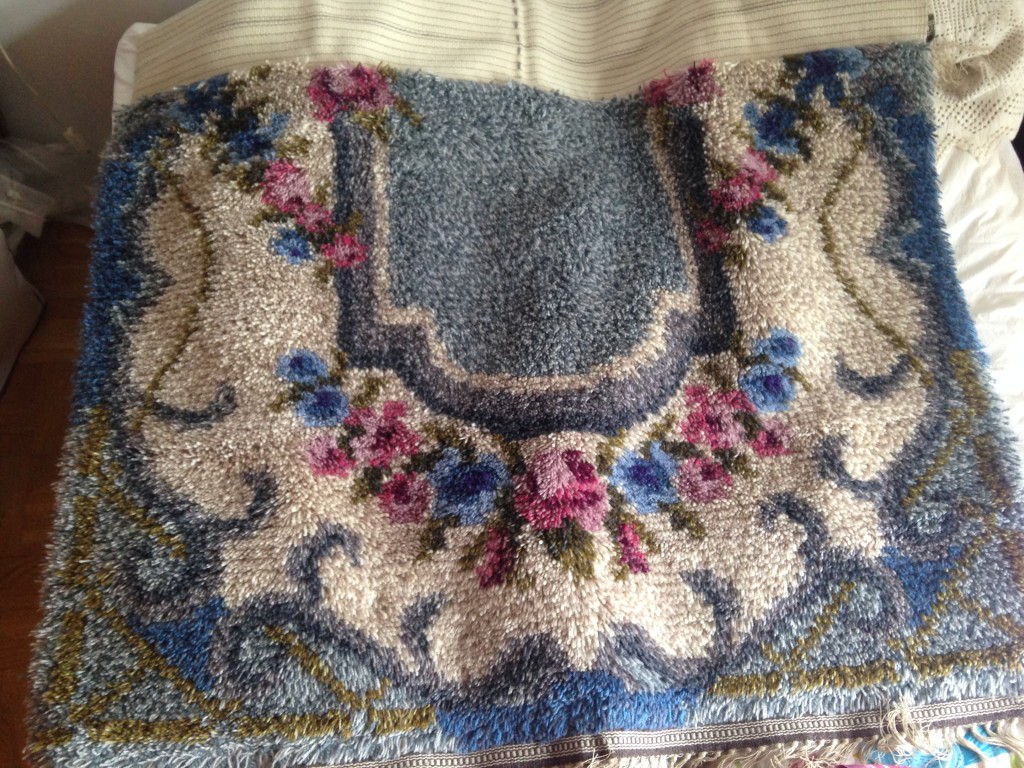
Mia from Sweden is working on this beautiful rya. She found the “kit” in a chest purchased at an auction. When she told me that she couldn’t find instructions on how to make it (in Sweden) I realized how important is is for me to get the word out on making your own rya. Mia has offered to translate my book into Swedish when it is done. I better get to work.

And here is another great one…

Kay Ahearn's Spaelsau rya

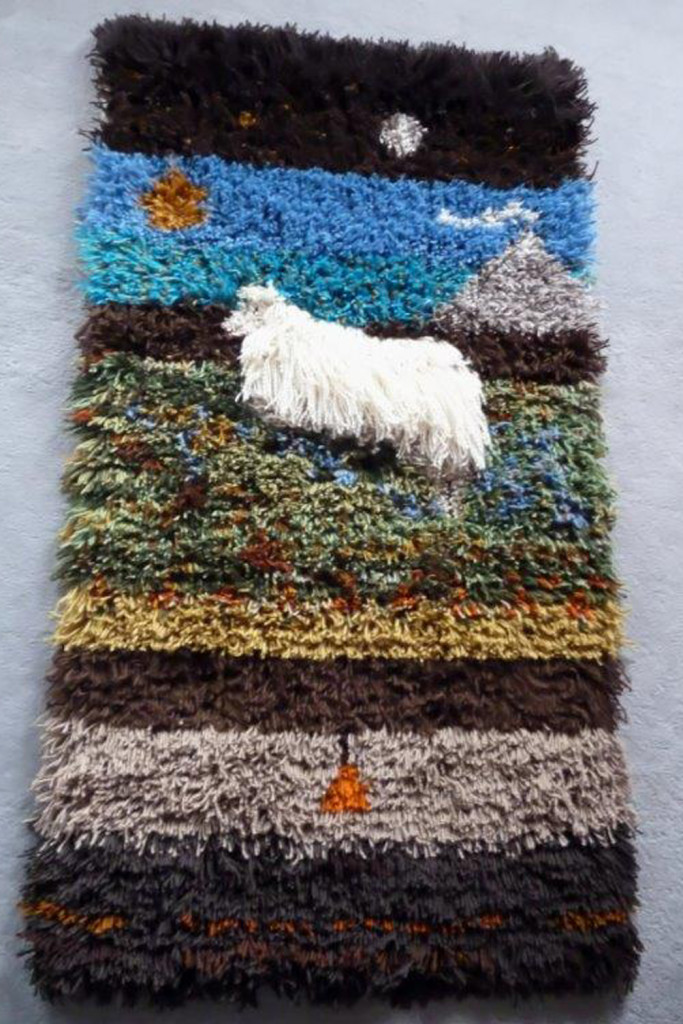
This is a truly international rya with a great story. Kay from New Zealand has just completed it, but she is still tweaking it in certain aspects. She started by buying a Finnish backing from me. Then she emailed me her design idea and we calculated yarn amounts needed online. My Lundgren yarn is spun in New Hampshire of New Zealand fleece, so half of the yarn she used came from her own “backyard.” Kay was helping me research sheep breeds in New Zealand, and historical rya breeds. She was the first to tell me about the Spaelsau sheep from Norway which is a heritage breed. The sheep in her rya is a SPAELSAU, so all the white wool in her rya is from Norwegian Spaelsau sheep! This is a masterpiece in my opinion and so much fun to watch develop over the miles. Thanks for sharing, Kay!

And another…

Grads,_shower,_rugs_054

And this one was recently sent to me by Janine who has made several ryas. She was kind enough to send me a large box of 23 lbs of extra rya yarn she had accumulated over the years. This one is a Swedish design which I was not familiar with. Very beautiful and soooo Swedish.

And another:

This is truly a blast from the past.  Imagine getting an email like this one I received a few weeks ago:

<<Melinda, was it you who gave a small class on making rya rugs in Concord MA in

1982? I am still working on my rug and now I vow to finish it and I am so happy

to have found you. I am sure it was you, anyhow you or a relative. This young

woman’s grandmother had developed her own line of colors and rya rug backing …

 I am so happy to see all your pictures, I am sure you are the same person!>>


beth Watson inspiration
From a photograph of a stegosaurus, Beth was able to see an interesting design in the skull and ear of the dinosaur. She blocked the image so she could graph it better.
beth watson graph
This is the graph paper she watercolor painted to create the design you see below. She used 27″ wide backing in two strips. One strip is completed and the other strip is nearly complete.


And here is Beth’s rug within days of being complete:

Beth Watson

Can you believe this design came from the inner ear of a stegosaurus? Creative people like Beth make me very happy to be doing the work I do. Thank you for sharing. Now, get to work and finish that rug so you can enjoy it on the floor! Thanks for sharing, one and all!

Thanks for those pictures.  Keep them coming, friends.  Feel free to comment and share below.

Cheers, Melinda

Studio Elves Hard at Work

DSCN6752

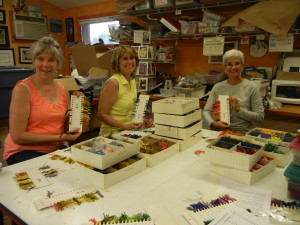
Jennie, JoAnn, and Karen each took on 10 color cards to load with yarn.

DSCN6754

JoAnn became very skillful at making skeins from big hanks of yarn with this antique skeining machine.

I held my first of many studio workshop days in Byrdcall Studio this week.  The goal was to familiarize helpful (and interested) friends in some of the day-to-day operations in the studio as they relate to my new rya rug design and supply “division.”  The other goal was to have fun with some awesome women folk who volunteered to help me get this “show on the road” as we made yarn sample cards and spun skeins from hanks of dyed rya yarn.  The less time I personally spend making yarn sample cards, the more time I have to work on my book on making rya rugs.

After a grueling three hours in the sweatshop, we enjoyed a variety of salads, bread, and guac&chips (by Karen) under the patio umbrella.  I believe everyone had a good time and I am very well supplied with sample yarn cards for a few weeks (hopefully).  Soon we will be putting together kits, organizing yarn displays, hemming backings for orders, and having more fun.  I have a few other people on my “helper list” who could not make it this week.  If you would like to help out some day, please let me know.  Thanks.

And very sincere thanks to these three women who caught on quickly and made my day a wonderful day!

DSCN6756

Karen and Jennie put finishing touches on the sample cards.

My Thoreau Linocut in Maine Woods!

Brookie-In-Color-sepI was very happily surprised to be found by Maine Woods Discovery last week.  They have coordinated a spectacular event to rekindle our spirit to connect with the woods of Maine. In 16 days, 7 canoes, and 14 paddlers retraced the 325-mile route taken during the 1857 trip made by Henry David Thoreau and Penobscot Guide, Joe Polis. The event was designed for the dual purposes of celebrating the 150th anniversary of the publication of “The Maine Woods” and to draw attention to the outstanding opportunities for quality, nature-based recreation, vacation, and travel experiences available in the “uninterrupted” landscape that makes up the The Maine Woods. Thoreau Simplify-Discover

I was contacted by a behind-the-scenes logistics man, Matthew Kovacevich, who wanted to know if they could use my linocut image of Thoreau with a “slight change” for printing onto shirts for the participants when they reached final destination on June 1st.  Of course I said yes, to be a part of this great event.

They blogged daily during the 16-day trip, posted progress, photos, weather reports, and basically relayed the feel of the adventure to the thousands of us at home watch via internet.  They asked me to write a blog posting which I will share with you here.  You can see that Henry and I go way back.  Read my blog here.  (Yes, that is a blog within a blog, but worthwhile, I think.)  And if you like this kind of thing, follow Maine Woods Discovery on Facebook…read previous posting to get a look at posted photos-really good photos!

Check out their web site to get a taste for the event. Click here to learn more about 150 Thoreau.  The crew of CBS Sunday Morning was filming where possible along the trek…and they filmed at the take out point.

Added on 8/13/14:  here is the link to the video of the Thoreau-Wabanaki Trek:  Click here to see 5 min. video.

Thanks for reading….Feel free to comment.

Melinda

The Odds of a Tattoo!

When something really amazing happens…the kind of thing that makes me ponder the universe, I like to share it with you.  One of those mind-blowing moments happened just the other day.  Here goes:  My husband and I were at the local nursery garden center picking out some new shrubs.  I kept wondering if we were looking at native varieties. Finally I said to John, I’m going to find someone to see if there is a section of just native species.  Bee! shirt

Jamie tattoo

My new friend, Jamie, at Sun Nursery sporting his new tattoo.

There were several staff around assisting clients.  I went up to a young man wearing a bandanna, and before I could ask my question, he said, “Wow, where did you get that shirt?”  I was wearing one of my hand-printed honeybee shirts–Bee!  I explained that I was the artist and I designed and carved the image… But before I could finish my little spiel, he extended his left arm and revealed the very same image tattooed on his inner arm!

After we both regained our composure, he went on to explain that a buddy of his had bought the shirt from a lady in Woodbine [guess that would be me].  They both liked the design very much. (obviously.) They had done a honeybee project in high school, and well, I guess they just decided to take the shirt to the tattoo artist, and requested that my Bee! be forever etched on their skin.Jamie arm tattoo

Frankly I am honored.  If you want to get my art tattooed on your body, go right ahead.  I’ll even drop by the tattoo parlor when it is done and add my signature.  If you ever want to get your picture in my blog posting, just send me a shot of any Byrdcall image tattooed on your body.  Makes my day.

Tattoo BrewerHere is another image of mine that I know  two guys got tattooed on their legs.  It is a logo I designed for a local homebrew supply shop.  Can you name the owner of this leg?  How about the Homebrew Supply Shop?

OK, who is next for their Byrd tattoo?

Step right up.


Buried Treasure in the Garden

gypsy in the hops 006My funny little dog, Gypsy, did it again. This past winter, she carried a 3 lbs. bag of potatoes out the doggy door, and proceeded to bury potatoes in all of my garden beds before I caught her.  I even found a potato in a bush about one foot above the ground!  A former stray, she must be preparing for the famine.

colors for Penelope

 Anyway, last week I was helping a rya customer select yarn by taking digital pictures with my iPhone of the yarn she was interested in positioned in sunlight so she could get a better idea of how the colors looked in the sun.  I often do this for people who don’t live close enough to stop by.  On a white board set just outside the studio door, I lined up 8 skeins of yarn, took a few pictures, then went in the house to email them to the customer.  An hour or so later when I was going back to the studio, the skeins were in disarray, but I didn’t think much of it…probably the wind. rya yarn in dirt The next morning after taking Gypsy for a walk, we were strolling the yard when a bright blue shone at me from under a decomposing log.  Looking closer, I could see it was a buried #51 skein of Lundgren yarn!    My precious yarn!

Now why would a dog bury a skein of yarn?  The next day my husband found another under the clothes line. What was she thinking?   But she is so cute!

Sign up for our Newsletter